Two black stones, one banded silica and one frozen lava, can look almost identical behind shop glass. Buyers mix them up constantly, and the difference matters: one will survive years in a ring, the other can chip on a car door and leave a curved flake where a facet used to be. The confusion is fair enough. Both are near-opaque, both take an impressive polish, and both turn up in the same strand of 8 mm beads at the same modest price. But the durability gap between them is wide, and the wrong choice can turn a favourite ring into a chipped keepsake inside a single summer. Here is how onyx and obsidian really differ, and how to pick the right one for the way you wear jewellery.
What onyx really is
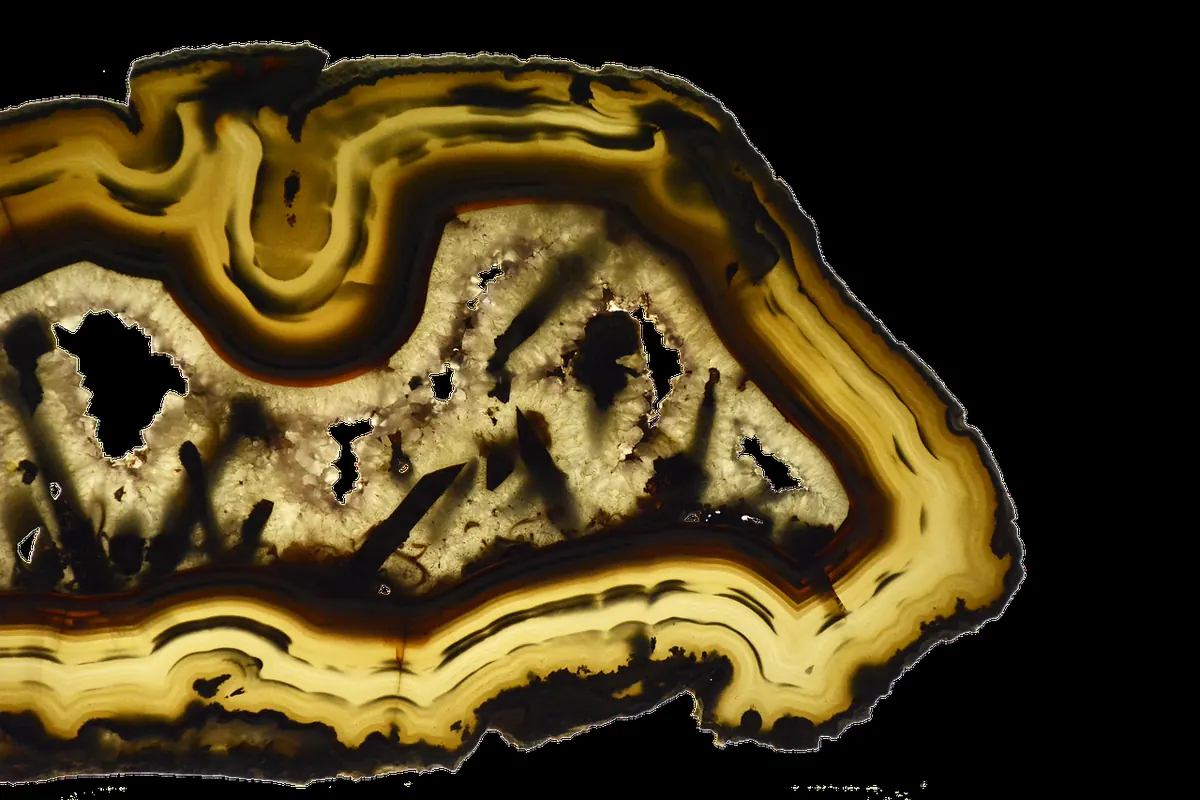
Onyx is a variety of chalcedony — microcrystalline quartz, the same family as agate and carnelian. Its defining feature is straight, parallel banding, unlike the curved, concentric bands of agate. The classic version is black and white; sardonyx, with its red and white layers, was the traditional material for carved cameos, and the layered structure is exactly why. A carver can cut through one colour into another to lift a pale profile out of a dark background.
Fully black onyx is uncommon in nature. Most chalcedony that looks black in the ground is really very dark brown or grey, and much of the uniform jet-black stone in shops is chalcedony that has been dyed, often with a sugar-and-acid treatment that leaves carbon trapped in the stone's microscopic pores. That is normal trade practice rather than a swindle, but it should be disclosed, and it changes how you look after the piece: heat, solvents and long sun exposure can all pull dye out of a porous stone.
One naming trap: "onyx marble", sometimes sold as Mexican onyx, is banded calcite used for coasters, lamps and chess sets. At roughly 3 on the Mohs scale it scratches with a copper coin, and a drop of vinegar will fizz gently on its surface. It is far softer than true onyx and is not quartz at all.
What obsidian really is
Obsidian is volcanic glass. When silica-rich lava cools quickly, its atoms never get the chance to arrange into a crystal lattice, so the result is glass rather than a mineral — geologists call it a mineraloid for exactly that reason. The black comes from iron and magnesium oxides and from tiny crystals of magnetite scattered through it.
It is not always plain black. Mahogany obsidian carries reddish-brown iron oxide streaks, snowflake obsidian holds grey-white clusters of cristobalite, rainbow or sheen obsidian flickers with layered iridescence when you tilt it, and Apache tears are small rounded nodules that look almost transparent in thin slices. Because obsidian fractures with smooth, curved surfaces — a property called conchoidal fracture — it can be worked to an edge sharper than steel, which is why ancient cultures used it for blades, scrapers and cutting tools.
On the Mohs hardness scale, obsidian sits at about 5 to 5.5. Onyx, being quartz, reaches 6.5 to 7. Same colour on the shelf, very different scratch resistance on your hand.
Appearance and origin, side by side
- Origin: onyx forms slowly as silica-rich water deposits layer after layer over centuries; obsidian forms in minutes to hours as lava cools.
- Structure: onyx is crystalline and fine-grained; obsidian is glass, and technically a mineraloid.
- Colour: onyx is usually even black or banded black and white; obsidian is black with grey, brown or rainbow tones and often looks translucent at thin edges.
- Feel: obsidian feels lighter in the hand for its size, and glassier to the touch; onyx has a denser, more stone-like weight.
- Finish: onyx takes a hard, mirror-like polish; obsidian shines too, but close inspection with a loupe can reveal faint pits, swirls and tiny round gas bubbles.
- Typical cuts: onyx appears as cabochons, beads, signet rings, intaglios and cameos; obsidian is most often cut into cabochons, beads, arrowheads and worry stones, because thin faceted edges chip easily.
Hardness, toughness and everyday wear
Household dust contains quartz particles at around 7 on the Mohs scale, so a stone left loose in a handbag or on a windowsill will slowly dull. Obsidian, at 5 to 5.5, loses its shine faster and can be scratched by a steel blade or by window glass. Onyx, at 6.5 to 7, shrugs off most of what a pocket, a desk or a keys-and-coins tray can throw at it.
Toughness matters just as much as hardness. Obsidian's glassy structure means a sharp knock can flick off a curved flake — the very quality that makes it useful as a blade works against it on your hand. Onyx resists chipping and abrasion far better, which is why it has been a staple of men's signet rings for over a century.
What that means in practice
- Everyday rings: choose onyx, set in a bezel or a low cabochon so the stone sits below the metal line. Avoid prong settings that leave corners exposed.
- Pendants, earrings and brooches: obsidian is perfectly happy here, since these pieces rarely take direct impacts.
- Bracelets: obsidian beads can crack where they knock against each other, so string it with knots or spacers rather than tight against hard neighbours.
- Stone-setting tools and blades: obsidian's sharp edge is a feature, not a flaw — just never treat a polished cabochon like a cutting tool.
- Children's jewellery: obsidian can flake into sharp fragments; onyx is the safer black stone.
How to tell them apart in a shop
You rarely need a lab. A few quick observations will usually settle it.
- Look for banding. Hold the stone against a strong light and turn it. Straight, flat, parallel bands point to onyx; swirling flow lines, colour streaks or a glassy swirl point to obsidian.
- Hunt for bubbles. A 10x loupe is enough. Perfectly round microscopic bubbles are a gas-trapped signature of volcanic glass and never appear in quartz.
- Check the edges. Look at the rim of a cabochon. Obsidian often shows tiny curved shell-like chips; onyx wears as small, angular nicks instead.
- Feel the weight. Two cabochons of the same size will feel different — obsidian is noticeably lighter and cooler at first touch.
- Ask about treatment. A straight answer about dyeing is a good sign. Vague answers about "natural black onyx" usually are not.
Skip the scratch test on finished jewellery. It works on rough stone and destroys value on anything polished.
Care, cleaning and common mistakes
- Dyed onyx: clean with lukewarm water and a drop of mild soap, dry with a soft cloth, and keep it away from acetone, alcohol, bleach and ultrasonic cleaners, all of which can strip colour.
- Natural onyx: tougher, but still store it separately from diamonds and sapphires, which will scratch it.
- Obsidian: wipe with a damp cloth. Avoid steam cleaners, sudden temperature changes and ultrasonic tanks, which can exploit internal stress lines and shatter the piece.
- Both: put jewellery on last and take it off first. Perfume, hairspray and sunscreen leave dull films that are harder to remove than they look.
- Black glass and dyed howlite are common stand-ins for onyx in cheap bead strands. If the price is a fraction of everything else on the tray, that is the tell.
Symbolism, value and which stone suits you
Both stones carry old reputations as protective, grounding materials. Onyx is traditionally linked with strength, discipline and steady resolve, while obsidian is associated with truth-telling and clearing away what no longer serves. Treat that as folklore rather than geology — but it is folklore that has kept both stones on wrists and altars for thousands of years.
On price, the two are closer than you might expect. Ordinary black onyx beads and obsidian beads cost roughly the same. Where they diverge is at the top end: fine rainbow obsidian with a strong, even sheen commands a real premium, and antique sardonyx cameos can be genuinely expensive, while large clean black onyx cabochons stay affordable.
So choose by use, not by look. If you want a single black ring to wear daily for a decade, buy onyx, ideally dyed-and-disclosed or naturally dark, in a protective setting. If you want a dramatic, affordable pendant, a pair of earrings or a tumbled piece to hold, obsidian gives you more visual interest per dollar — swirls, sheen and depth that uniform onyx simply cannot offer.
Match the stone to the job. Onyx survives a life of knocks; obsidian rewards a gentler one.
Photo: anncapictures / Pixabay